Live in minutes, without a dev.
The guided flow takes an agent from setup to running.

Set up an agent from a guided flow, no servers and no terminal. It runs on compute you are not tied to, your keys secured for you, your data yours to take.
accepting applications · read weekly
THE SECOND AFTERNOON
Getting an agent takes an afternoon now: pick one, try it, watch it answer. Then comes the second one: a server to set up, keys pasted into a config file, a billing tab open in another window, and a system only you can keep running.
The first afternoon got easy. The second one did not.
Undergryd exists for the second afternoon. Pick the agent; it takes care of where and how it runs.
1
Pick an agent from the catalog, and a guided flow takes it from there. No terminal, no server to rent. You enter your keys once during setup; the platform stores them securely, scoped to the agent that needs them. AI models are included: a managed mix across providers, nothing to wire up.
2
Your agent runs on decentralized compute you are not tied to. No lock-in is a design decision here: what Undergryd receives is a configuration, not your codebase, and leaving costs a config change, not a rebuild.
3
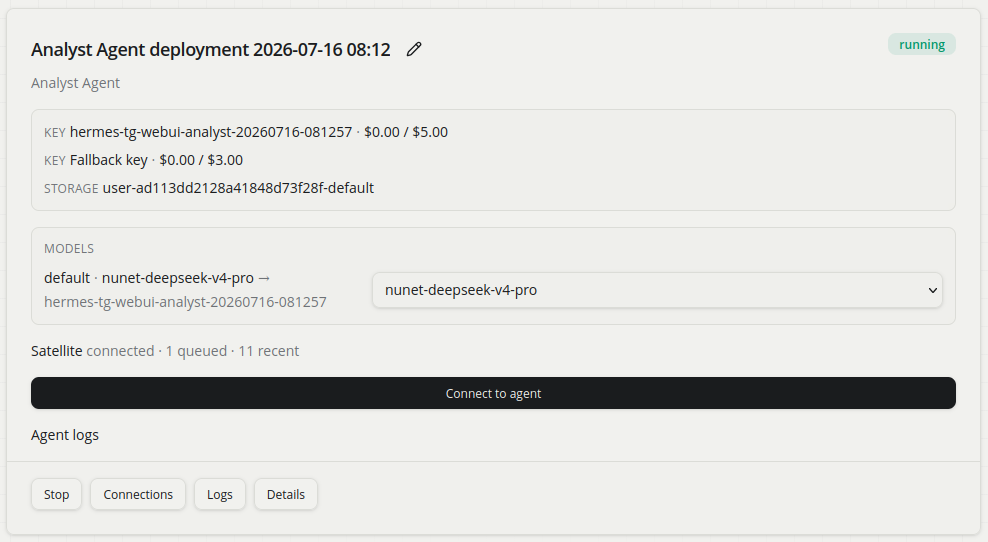
Your agents live in one place, managed from the browser instead of a terminal. See every agent and whether it is running; start it, stop it, restart it; read the history of what it did.
The guided flow takes an agent from setup to running.
Every new agent deploys the same way: the same guided flow, minutes not hours, and no new server to buy, configure, or babysit.
Enter a key once. It is stored securely, and each agent's integration keys are its own, not shared across everything you run.
Built-in storage that speaks the same S3 standard your other tools do. Sync it, export it, take it with you. The exit is part of the design.
Credits load up front, so you always know what has gone in. Nothing bills you in arrears, and nothing can spend past what you load.
If you run agents for clients, the hard part stopped being the build a while ago. It is onboarding client number four without losing another afternoon to server setup, and knowing what is running where once the client list grows.
Onboarding a new client used to mean another server, another setup, another handful of hours. Here it means running the guided flow again.
Early access is limited and by application, read weekly. Accepted teams get compute as free credits during early access, the guided path from setup to a running agent, and the people building the platform in the same channel as the people using it. It is a small team; that is a feature, honestly framed.
The ask in return is blunt: run real agents on it and tell us what breaks. Reliability is measured in the open, and the first published numbers will come from this cohort's runs.
Early access is limited and by application. Tell us what you run — we read applications weekly.
A builder asks you to assemble an agent inside its walls, and what you make stays there. Undergryd starts where builders end: working agents, ready to run. Pick one, set it up for your business in a guided flow, and it runs with your keys secured for you and your data yours to take. Leaving costs a config change, not a rebuild.
A VPS hosts what you configure, and hosts it well. But it hands you the second afternoon: the setup, the keys in a config file, the billing tab, the maintenance. That afternoon is exactly what this replaces.
What Undergryd receives is a config, not your codebase. Your data sits in storage you can sync and export at any time. Dependence on a layer you can leave is a different thing from a garden with a gate.
Ready-made agents you set up for your own business, from a catalog that is deliberately small during early access. If the agent you need is not there, apply and say so; early access exists to find out what people need next.
It reads under-grid: the grid beneath your agents. Say it UN-der-grid.